Tag Archives: Ho’oponono
Clearing the Mind

Clearing the Mind

Traffic JamClutter. I have it in my office. I have it in my shop. I have it in my home (although mostly in my areas, not my wife’s). I can live with all that. What I have a problem with is the clutter in my mind. Constant self-talk, thoughts, judgments, predictions.

What does clutter in the mind feel like? To me, it feels like a traffic jam on Times Square, with thoughts and expectations and fears all trying to get through the intersection at the same time. Clearing the mind brings calm and order, a sense of peace, and the ability for me to get where I want to go.

Sleep experts tell us that racing thoughts are common with anxiety disorders such as obsessive compulsive disorder and attention deficit hyperactivity disorder. But we all experience this buzzing clutter at times. The thoughts distract us, unfocus us, and generally contribute to an increasing level of stress.

How can we temper these thoughts, and thus decrease our anxiety?

There are a number of ways to get things out of your head. Here are a few I use:

Ho’oponopono

Ho’oponopono proponents refer to the affirmation as “cleaning,” as in cleaning out one’s mind. Whatever thought, prediction, or fear is troubling you, it can be tempered by cleaning. I’ve experienced this often and find the affirmation extremely productive.

As an example, I had a client who harbored trepidation about initial meetings with high-dominant business owners. Once he got started in a conversation he was fine, but getting off the ground was scary.

Ho’oponopono (I love you. I’m sorry. Please forgive me. Thank you.) cleared his fear as he aimed the “I’m sorry” at his Knower/Judger interpretation that the other person should and would be worthy of his fear. He would utter the affirmation upon entering the target exec’s office, stick out his hand, and introduce himself. After mastering this technique, his ability to greet and connect with perfect prospects has improved dramatically…as has his success.

Meditation

Meditation has been described as a family of self-regulation practices that focus on training attention and awareness in order to bring mental processes under greater voluntary control. It results in improved mental well-being and helps you develop capacities such as calm, clarity, and concentration. What better way to clear the mind than to foster calm, clarity, and concentration?

People from all walks of life—athletes, actors, academicians, musicians, politicians, business pundits—use forms of meditation to maximize the mind’s capacity to support them in achieving their goals and to avoid getting hung up on all the clutter that gets in the way. 

I’m not a practiced or regular meditator. But I have used meditation on several key occasions in my life as the method of last resort to get my head cleared of thematic clutter interfering with my personal clarity. 

Breathing

A subset of meditation, easy breathing exercises can help oxygenate and calm. They can be quicker and easier to integrate into your day as well. I use breathing frequently. I think it has a lot to do with my mother saying “Just breathe” whenever I was injured or shocked or stunned. I was prone to panic attacks as a young boy, and this technique worked wonders on me. Still does.

Journaling

Just jotting down some of the thoughts racing through your head can relieve your mind of its self-proclaimed duty to address all that “stuff” and is a good tool to use before bed. Writing it down tells the cluttered mind that we’ve already dealt with that issue. In journaling, I like to track what’s going on in the rest of the world (perhaps another person involved in the thought that’s bothering me), what’s going on with me (where am I coming from in this transaction), and how I feel about it. I find that last one both difficult and exposing. Identifying what we feel about things, in my experience, contributes more to calm and clarity than identifying what we need to do about things, so get those feelings down if you decide to journal.

Exercise

Exercise promotes oxygen circulation and endorphin flow, and forces concentration away from the clutter in the mind and onto the activity. I don’t use exercise specifically to clear my mind. I use it as part of my everyday operating system because it is so energizing. I drag myself into a workout before 6:00 a.m. and 90 minutes later bounce out ready to tackle anything, after a great workout, a few minutes in some steam, and a wonderful shower. I suspect if I removed exercise from my routine, my mind clutter would actually increase. 

There are many other ways to clear the clutter of our thoughts. What are yours? We all have them, but sometimes we forget to use them. Putting these techniques into action generates a huge payoff. Our mind runs our lives. What we conjure up in that clutter becomes our reality. Leaving it to random chance and outside influence takes away our God-given free will. Why let that happen?

Share
It’s Always the Other Guy

It’s Always the Other Guy

Since I deal in frustration, stress, and struggle, I’m frequently engaged by leaders to work my magic on their teams. The problem, these leaders often suggest, is that people have a hard time listening. They make the same mistakes repeatedly, or don’t communicate well with the team. They are the source of the boss’s frustration, stress, and struggle, and my job is to change them. But what’s the one thing all these people who cause so many issues have in common? Their leader!

Now I have several clients and past clients who read this newsletter, and please know that I’m not talking about all of you. It is not uncommon, however, for me to hear about Sally who just can’t seem to get all her work done in 40 hours a week. Or Martin who agrees to get something done, but somehow never gets around to it. Or the “games people play” politically in an organization.

What can I say? It starts at the top. The unifying link is the boss. For those of you who are the boss and are experiencing some of these issues, this is good news, because it means that the one person who can effect the most positive change is you.

Changing the Dynamic

I’ve frequently referred to the Hawaiian affirmation, Ho’oponopono.  Ho’oponopono’s message is that we are all responsible for everything. Spiritually, the Hawaiian shamans (and Buddhists and others) believe that we are all connected…not only humans, but all living things. When we interact, we affect everything in the universe.

If we believe this, then it becomes our responsibility to interact with everyone and everything in a universally productive manner. (Karma’s a bitch.) If we expect a problem with a direct report, then we, in essence, create that response. To be productive, we change our expectation and say the affirmation:

I love you.

I am sorry.

Please forgive me.

Thank you.

In simple English, we are asking the other party to forgive us for harboring the belief that he or she can or will fail us.

Now I’m not suggesting we just think happy thoughts about everybody and all the frustration, stress, and struggle will evaporate (although I suspect it would help). I am suggesting that neutralizing a nonproductive forethought gives us a better chance of creating a successful outcome. And if, as Ho’oponopono suggests, we create and are responsible for an outcome by imagining that outcome, think of the power we have over fate. Think of how we can change our interpersonal environments.

You probably have many counterproductive tapes that you replay with people close to you in your office, family, or rally team. What if you took those repeated interactions and just thought:

I love you.

I’m sorry (for preparing for the same old bullshit debate we’ve had forever).

Please forgive me (for thinking in the past that you’ll do what you’ve always done, so you don’t have to do it this time).

Thank you (assuming you are forgiven).

This powerful affirmation can keep both of you from playing your repetitive roles in your game of struggle.

I remember an interview with a leader many years ago. She lamented that she had challenges getting people to do what she felt they had agreed to do. “Who?” I asked. “My direct report, for one. Oh, and my husband. And my daughter. And my assistant at the charity I work with.”

I simply asked: “See any common thread?”

She did not. Her Knower/Judger insisted on maintaining her prediction that people close to her would fail her. This made her right, which was important to her. It’s a common thing. We are often blind to our own prejudices and limitations. In fact, Pogo could be right: “We have met the enemy and he is us.

So you’ve got frustration, stress, and struggle? Maybe the source is not “out there.” Maybe it’s “in here.”

Share
The Question That Can Change Your Life

The Question That Can Change Your Life

Wow! Last week, I participated in a branding strategic implementation meeting with a client and his new branding gurus, goBRANDgo. They covered all the usual questions—How is your industry perceived?, How are you perceived?, etc.—and then they asked something that left my client dumbfounded and impressed the heck out of me.


After quickly scribbling down about 30 responses to the question “What do you promise your clients?” my client’s team was asked this zinger:

“What do you promise yourself?

A pin hitting the floor would have rung out loud and clear. Skillfully, the facilitator, Brandon, remained totally silent until one of the participants identified his inability to answer that question.

Isn’t it a great question?

Most of us don’t promise ourselves a whole lot. I think it’s because our Knower/Judger function knows that when we promise something, we’re honor-bound to do it. We can fail someone else and rationalize it. But somehow we can’t bring ourselves to BS ourselves! So we mostly avoid the exercise.

Don Miguel Ruiz penned the book The Four Agreements about 15 years ago. It’s a short book with some potentially constructive concepts related to making deals with yourself. They’re promises, and if you make them to yourself, I think you’ll definitely find yourself more in touch with your Learner/Researcher.

The Four Agreements:

1. Be impeccable with your Word: Speak with integrity. Say only what you mean. Avoid using the Word to speak against yourself or to gossip about others. Use the power of your Word in the direction of truth and love.

While I would replace the word “truth” with “reality” (since the HDClarity tools define truth as reality viewed through K/J filters), this agreement suggests we use unfiltered data and remove all preconceived thoughts about who we’re talking to at the time…à la Ho’oponopono.

2. Don’t take anything personally: Nothing others do is because of you. What others say and do is a projection of their own reality, their own dream. When you are immune to the opinions and actions of others, you won’t be the victim of needless suffering.

K/J voices in our heads convince us that what’s happening to us or being said to us is some personal attack or vendetta and that we should take up a defensive position. Hence the K/J vs. K/J conflict. When we can stay out of that, we contribute continuously to calm in our immediate environments. It’s the other guy’s problem, not yours.

3. Don’t make assumptions: Find the courage to ask questions and to express what you really want. Communicate with others as clearly as you can to avoid misunderstandings, sadness, and drama. With just this one agreement, you can completely transform your life.

Mary J. Lore, author of Managing Thought, says we have 60,000 thoughts per day during waking hours. Most of them judge something. Right/wrong. Good/bad. Pretty/ugly. Smart/dumb. Our K/J takes those thoughts and creates conclusions, which may or may not be accurate. I totally agree with Ruiz on this point. Getting this under control will completely transform your existence.

4. Always do your best: Your best is going to change from moment to moment; it will be different when you are healthy as opposed to sick. Under any circumstance, simply do your best, and you will avoid self-judgment, self-abuse, and regret.

100%. No more, no less. I wrote an article a time back on how athletic coaches sometimes implore their subjects to give 110%. In my world of racing cars down gravel roads at over 100 miles per hour, 110% typically means the car is going faster than the driver can handle. This usually ends up in crashes. Yet giving only 95% leaves something on the table.

My agreement with my drivers has always been, let’s give every challenge (every turn, every engine modification, every call from my notes) 100%. If we do, then we’ve given ourselves the best chance to win. If it’s not a win, nothing we could have done would have made a difference. We just got beat by a better team, car, or driver that weekend.

What do you promise yourself? What deals does your K/J make with you that are working for you? Which ones aren’t? You might consider the Four Agreements as a good starting point.

Share
The Forgiveness Thing

The Forgiveness Thing

“To err is human; to forgive, divine.”
Alexander Pope (1688-1744)

It’s not the “err” thing I want to talk about. It’s the “forgive” thing. I understand people’s ire when something has been irretrievably taken from them. Theft comes to mind. Possessions. Virginity. Life. But the act of forgiveness is incredibly powerful. Let me show you what I mean.

How often have you gotten angry about one of these kinds of scenarios?

  • Your secretary forgets to update your calendar and you miss an important meeting.
  • Your customer service representative overpromises a solution to an irate client. Or worse, she gives them a piece of her mind.
  • Your son brings the family car back with a little ding in the front fender.
  • A direct report misses the accuracy mark on some calculations.

Most of these scenarios conjure up a “punishment” response, ostensibly to improve the odds that this doesn’t happen again. After all, we’re perfect and we just want to help the other guy be as perfect, right? But these are all errors only insofar as they are judged by our Knower/Judgers to be so. They are not intrinsically wrong. They are what they are, and they don’t match our considered opinion of what’s right. But that’s our opinion, developed from our K/J rules of life.

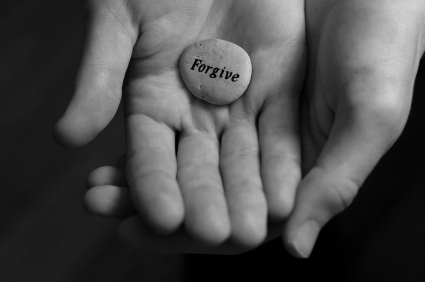
Ho’oponopono speaks: I love you. I’m sorry. Please forgive me. Thank you. Now I challenge you to say that and then follow through with whatever punishment you had in mind.

“Between stimulus and response there is a space.” Try sticking Ho’oponopono in there!

“But, Kim,” you say, “How will I ever train the person to do things the way I want them done?” You’re asking to have the whole world accommodate your K/J (and incomplete) picture of the world, aren’t you?

The act of forgiveness is truly universal in its ability to stop the madness. What can we ask forgiveness for?

  • Foisting our K/J rules on others
  • Making snap judgments
  • Reacting rather than reasoning
  • Failing to see data that supports the other argument

The list goes on.

Do you like conflict? Then hold your position. Want peace? Forgive.

Now I’ve really got you riled up. “How can I ever get my way? Everyone will just run over me. I’ve got to stand up for what’s right!

Consider the benefits of forgiveness, like these from the Mayo Clinic:

  • Healthier relationships
  • Greater spiritual and psychological well-being
  • Less anxiety, stress, and hostility
  • Lower blood pressure
  • Fewer symptoms of depression
  • Lower risk of alcohol and substance abuse

Sticking to your K/J as the supreme decision maker about right and wrong appears to have dire consequences in our lives. It’s tied into that challenge we frequently see of always needing to be right.

Back off. You might even be wrong (gasp)!

Just how angry can you get over a missed appointment? A dinged fender? How much damage do you want to do to the relationship with the offending party? Forgiving stops that.

Share
HDClarity Tool Set: 7 Tools for a Clearer Picture

HDClarity Tool Set: 7 Tools for a Clearer Picture

Every article or video that’s appeared in this column is a tool for those who might want to change something, but who find their personal resources incapable of getting them there. We all need tools to enhance our innate capability to do things, and we often require a certain level of training and expertise to use them without hammering a thumb or cutting a finger. Here are a few of the many tools my clients and I use to get results and make changes, as well as quick links so you can learn how to use them effectively.

Understanding Personas: Knowledge, while valuable and serving productive purposes, impedes learning. We don’t learn when in the Knower/Judger persona. So understanding the foundations of your K/J persona and being able to set it aside and use your Learner/Researcher is a tool. Without this tool, you are only capable of what you’ve been capable of so far. New data has a hard time penetrating what you “know.”

Choosing Nice: When you know you have a choice to be right or be nice, picking nice is a tool that can repair damaged relations. But, just like using a saw, it takes some practice and skill development.

Drama Triangle: The Drama Triangle is another indispensable tool when working on teams. Understanding the persecutor/victim/rescuer roles and watching them at work (even if you’re playing one of the roles) can bring clarity to any team struggling to break the bonds of repeated patterns.

Ho’oponopono: This is an incredible tool I often use to neutralize my K/J when it begins to exert itself. Ho’oponopono helps us understand that we are all accountable for our relationships with everyone and everything. An outcome cannot be counterproductive unless that negative outcome is first manifested in the K/J.

Giving Up: Giving up expectations—the last gift from my mentor Jut Meininger—has been effective in reducing my levels of frustration. Expectations are always products of the K/J, so the frustration experienced when expectations don’t pan out is one of the more repairable pieces of the human condition.

Three Responses: Eckhart Tolle’s three responses (engage enthusiastically, enjoy passively, or accept) have been incredibly useful to me as I struggle to recover from K/J disappointments.

Taking It Easy: One of my effective tools is just recognizing that I am still a pilgrim on this path, susceptible to falling off the wagon and smacking my thumb with my tools (sometimes even forgetting I have the tool), and that is part of my journey. I have grown very thankful to the clients and readers who point out my K/J moments. It means my tools are being picked up and used.


Share
Bad Turns to Good with UPR

Bad Turns to Good with UPR

Remember the story of Dr. Hew Len at the psychiatric hospital in Hawaii? He used the Ho’oponopono affirmation each time he came into contact with an inmate: “I love you. I’m sorry. Please forgive me. Thank you.” The results were impressive. The concept is based on the idea that we are responsible for everything and everyone, creating “bad” and “good” people and situations out of our (flawed and incomplete) Knower/Judger concepts. But over the past eight years, I’ve coached many leaders, executives, and family guys who have had a hard time even thinking “I love you” while approaching an arrogant boss. So let’s modify this highly effective tactic to make it more palatable.

In the early 1960s, psychologist Carl Rogers focused his attention on the concept of unconditional positive regard (UPR). David Myers, in his book Psychology: Eighth Edition in Modules, gives us a very clear definition of UPR:

This is an attitude of grace, an attitude that values us even knowing our failings. It is a profound relief to drop our pretenses, confess our worst feelings, and discover that we are still accepted. In a good marriage, a close family, or an intimate friendship, we are free to be spontaneous without fearing the loss of others’ esteem.

An example of the power of UPR is the relationship between Republican President Ronald Reagan and Democratic Speaker of the House Thomas “Tip” O’Neill. Aggressive political opponents with opposite views on how the country should be managed, they never thought ill of each other. In fact, they were close friends. When Reagan was in the hospital after the assassination attempt, O’Neill was his first visitor.

If we don’t agree with someone’s K/J judgment, can’t we still regard that person highly? When we get into a debate with a co-worker, it’s quite normal to see his side of the argument as a personal affront. But maybe he has the company’s best interest at heart just as you do. You just have different paths. Does that make him your enemy? Can you not debate constructively and still go out and have a beer after work? If you face each other with mutual UPR, you can. And your mission will be the better for it.

Rogers discovered that most of his patients struggled with self-worth issues because other people (parents, teachers, significant authority figures) had told them what their value was. UPR helped them feel better about themselves. So using Ho’oponopono is a little like becoming a therapist for a moment.

As an interaction begins, embrace a feeling of UPR for the other person. At least momentarily, set aside your preconceived notion that this person is “bad”…an enemy, threat, someone to fear. The conversation will begin from a different point and head off in a completely different direction than it would otherwise.

Ho’oponopono at Work

I have a client who harbored a fear of High Dominant business owners. If he were a teacher, this would likely pose no problem. But he made a very good living by selling his wealth-management services to High Dominant business owners. His phobia was beginning to negatively affect his income.

I won’t go into too much detail, but he discovered that his “one-down” position in these conversations was generated early in life in his relationship with his father and others in positions of authority. Perhaps you’ve experienced the same thing.

Ho’oponopono is based on the idea that you are responsible. If you think the other person is going to be trouble, that’s what you will experience. If you can abandon that K/J precept, then the other person can be anything you want him or her to be. Using Ho’oponopono, this client took responsibility for the other person in the conversation and made him into a less threatening individual.

Like this client, you might have trouble standing outside the door of a future customer saying an affirmation that starts with “I love you.” But how about “I have unconditional positive regard for you”?

The “I’m sorry” helps us admit that we need to own up and garner forgiveness for our K/J judgment of this individual or situation.

“Please forgive me” is actually you forgiving yourself for struggling under these misconceptions.

And “Thank you” is acknowledging that, at least for the moment, your K/J’s preconceived, troublesome projection of this conversation is gone.

Now the coast is cleared. The conversation will not go as you originally projected. You are free to succeed.

Share
Who Loves Ya

Who Loves Ya


In the chick flick Eat, Pray, Love, Julia Roberts’ character (a confused middle-aged woman looking for something that I never quite figured out) tells Javier Bardem’s character, “I don’t have to love you to prove I love myself.” At this point in the movie, most reviewers poked a finger down their throats and gagged, but I found a usable message that we can all use to improve the relationships with the people we love.

Byron Katie, author of Loving What Is, says that when we say “I love you,” we’re not actually dispensing love; we’re merely reporting the state we’re in. The problem is that the other person usually takes this information as a personal benefit. We tend to perceive this statement as positive regard when it’s only a report. In short, telling someone “I love you” is all about the transmitter. It’s nonspecific, noncommittal, and used to give a pseudo-benefit to the receiver. This opens the door to thoughts on the receiver’s part like “If he doesn’t tell me he loves me, something must be wrong.”

The “I have to love you in order to prove I love myself” is a Knower/Judger rule, learned along the way somewhere. Early childhood infatuations are frequently built around the “I’ll tell you I love you if you’ll tell me you love me” rule. My experience is that many of us grown-ups discover this rule isn’t working, but we don’t know why.

Let me ask you a question. If you had a choice between hearing “I love you” or “You did a fantastic job on…,” which would you prefer?

Option A explains the condition the transmitter is in. Option B proffers positive regard for the receiver.

Changing the game

A subtle shift in the “I love you” game is to tell someone that you love what he or she does or has done. Totally different. In psychological terms this is called a stroke because it dispenses positive regard, making the other person feel good. We all require strokes. They make us feel competent, included, brave, etc.

Another shift is to focus on yourself. If saying “I love you” benefits the transmitter, then saying it to yourself in a mirror works. Hence Javier’s character doesn’t need to tell Julia’s character he loves her. She can do that for herself.

But do we love ourselves? Or do we rely on assessing another’s state to validate ourselves?

Here’s why Ho’oponopono works. In this context, the four lines said to another (the first of which is “I love you”) truly describe the transmitter’s feelings since the words are not actually said to the target. When my clients really understand the dynamics behind Ho’oponopono, they understand that it’s all about them, not the other guy or gal. They are then accountable for how loved they feel.

Javier’s character has some options. He can create that warm, delectable state between two lovers—actually two who are in the state of loving themselves and choose to exchange warmth and cooperation—by using strokes. Strokes are judgments exchanged between K/Js that work. (Remember not all K/J interaction is negative.) I make a positive K/J judgment about you, and your K/J feels good about it.

“My God, you’re beautiful tonight.”

“I’m totally blown away by that article you presented.”

“You look fantastic in front of your gun safe.”

OK, some of these sound a little comical. But if you’re the receiver of the last quote, I bet you’d never prefer a pedantic “I love you” to such a positive stroke.

Who said love isn’t complicated? I don’t want everybody to stop telling their spouses, lovers, significant others that they love them if they do. It’s a comfortable part of your K/J pattern. I just want people to experiment with stroking—stating positive personal regard—using clearer, more productive words that really mean something to those you love. Give it a try!

Share
9/11 – Loving What Is

9/11 – Loving What Is

9-11Ten years ago, some people who didn’t like the United States of America and what it stands for hijacked airplanes and caused havoc. They took the lives of about 3,000 innocent people—people who were simply in the wrong place at the wrong time. It’s an event that’s hard to love, but in an amazing way that is exactly what’s happening. Read more

We grieve more when a life is cut short than when a full life comes to an end. There is so much unfinished business. Kids to raise. Degrees to complete. Rallies to win. Fortunes to earn. Fun to have. Grief multiplies with the early death.

When 3,000 lives are cut short within the span of about two hours, the grief is overwhelming. I suspect most of us either knew someone who died or know someone who knew someone. And that makes it even more difficult to bear.

The premature loss of thousands of people who were close to us—in one quick sweep of fate—creates the perfect storm of grief.

But what is grief?

Here’s what happens. Our Knower/Judgers become comfortable with the expectation that we, and others, will live about 80 years. Not reaching that ripe old age is, by definition, an unmet expectation, which develops into a huge frustration! This causes us to cry and rage and throw uncontrollable tantrums in agony. “Not fair!” we scream. “How could God do this to us/me?”

That 80-year data point is an average. Some people live to 110, others pass away naturally by 50. Some are genetically disposed to short lives. Others are graced with the genes to last so long they don’t even want to be here anymore.

Our K/Js get so comfortable with that 80-year mark that we think of it as a guarantee. But really it’s what statisticians call the gambler’s dilemma. For example, Albert Pujols is a .300 hitter. He’s gotten two hits in his last nine at bats so he’s guaranteed a hit this time at bat, right?

It doesn’t work that way. He’s still a .300 hitter, and he has a 30% chance this time at bat, just like every other time he’s at bat. That means he has a 70% chance of not getting a hit.

In the lifespan example, 80 years is an average. Some of us will reach 80 and beyond, and some of us will not. Some of us will pass from natural causes, and some of us will die prematurely.

We feel a pang of frustration (mini-grief) when Albert Pujols strikes out and only goes two for his last 10. And that’s just a game. We feel true grief (major frustration) when a child or a young parent dies prematurely. We get seriously in our “get-even” K/J mode when someone knowingly causes this death (the frustration is too great). And there’s no describing the intensity when it happens 3,000 times in two hours.

While our government took severe and violent action in the aftermath of 9/11 (and the actions and their costs continue today), I applied Eckhart Tolle’s three reactions concept. Tolle says that there are really only three reactions anyone can have to anything. We can engage enthusiastically, we can enjoy passively, or we can accept.

So when 9/11 happened, I could choose one of the following: engaging enthusiastically, enjoying passively, or accepting. Like many people, I originally chose accepting. Shit happens. Men have been attacking and killing each other since they were cavemen.

But this past weekend I saw signs that a lot of the country has moved up the chain to enjoying passively or even engaging enthusiastically. While tears flowed, most found strength in remembrance. Children who never met their fathers found words to make us all feel a little more comfortable. Lost sons, mothers, sisters, and brothers were remembered fondly, with little anger toward the individuals responsible.

This is not just accepting what is. It is loving what is. It is healing.

Share
I’m so Pissed

I’m so Pissed

So Pissed CarEver have one of those days, when it seems the universe has it in for you? Well I have a little secret that can help you get over that feeling and actually change the situation. Hint: It’s not the universe that’s responsible.

Pogo was accurate when he said “We have met the enemy and he is us.”

Sure, stuff happens. But, as Lou Holtz (famous football coach and motivational speaker), tells us: “Life is 10 percent what happens to you and 90 percent how you respond to it.”

Most of us have experienced the “chain reaction” bad luck sequence. It’s the foundation of much movie humor. The heroine is ordered to go out and buy coffee for the meeting. At the coffee shop, she finds that her credit card is maxed out. Looking for change, she inadvertently empties the contents onto the floor then finds she doesn’t have enough cash for all five coffees. She skips her coffee. On the way back to the office, her heel sticks in a grate, causing her to stumble and spill three coffees down her new Armani suit. Disheveled and wet, she limps into the meeting, gives her boss the remaining coffee, and hears him ask, “Cream?”

Yeah. We’ve all had those days.

The good news is that getting through those days only takes two things:

  • Recognizing that you’re in the downward spiral
  • Deciding to get out of it

Here’s your plan:

When the first incident occurs that causes you to exclaim, “I’m so pissed!” prepare for what happens next. Look around for the next bad luck attack. If it doesn’t come, then this is just an isolated case of no statistical significance. But if the next thing that hits causes you to say, “Now I’m really pissed,” you’re headed for a negative adventure. It’s like watery eyes predicting you’re headed for a full-blown sinus attack. It’s a signal!

Viktor Frankl’s famous quote comes to mind: “Between stimulus and response there is a space. In that space is our power to choose our response. In our response lies our growth and our freedom.”

A real-life example

Some years ago, my wife and I were headed on vacation. The day of our flight, I had to drop the dogs at the kennel, pick up my wife at her office, and drive us to the airport. Oh, and arrange our seats. I planned to negotiate with American Airlines en route.

I had it all timed out. I loaded up the boys and headed for the puppy camp office. Sign on the door: Closed Wednesdays. And then it started to rain. I would now have to drive 27 miles to the actual kennel down I-44, and I certainly had not accounted for that in my time estimate. I’m so pissed.

Slamming the car into gear and dialing my wife’s office to inform her of this ridiculous situation, I raced through our little town. I crested a little rise on wet Elm Avenue only to mate with a stopped pickup truck. Nailed him. Dogs ended up in the front seat. My hood and front grill were crushed on his hitch ball, but he insisted on taking all insurance papers and so on. Now I’m really, really pissed. How could this get any worse?

As I pulled onto the interstate, I noticed the damaged hood bobbing slightly. That was the stimulus. I took a deep breath (space), pulled over, and thought rationally about what needed to be done to avoid something else happening. Check the hood. The hood was unlatched and would have flown up over my windshield had I continued. In 15 seconds, I had interrupted my run of bad luck.

As a rally co-driver, I had the skills to figure out how much time it would take to drop the boys, get back to my wife’s office, and get to the airport, and how fast I needed to go. I upped the speed and dialed American Airlines. I was in super efficiency mode now! Making a long story short, we made it to the plane (barely) and had a wonderful week in Colorado.

This incident hatched the above-mentioned plan. Since then, in the downward spiral of a bad luck sequence, the second issue becomes my stimulus. I choose that there not be a third. That’s a conscious decision. That’s the 90 percent “how you respond.”

Try it, and let me know how it works for you.


Share
You Know the Type, but Do You Really?

You Know the Type, but Do You Really?

We only have one opportunity to make a first impression, and sometimes we don’t even get that opportunity. Almost universally, we make judgments about people as soon as we meet them. Tall, short. Fat, skinny. Attractive, unattractive. Cool, uncool. Rich, poor. My kind, not my kind. Are the judgments you’re making getting in the way of your success?

A client of mine had a preconceived issue with company owners, his exact target market. He prejudged them all to be high dominants, and his life experience (Knower/Judger rules) didn’t allow him to handle high dominants well. So when he interacted with them, he would enter the conversation with fear. His presentation was weak and unimpressive. Sometimes these targeted prospects were nothing like he prejudged them to be, but since his K/J had already categorized them, the presentations all went about the same. His career was in a tailspin.

We all make these kinds of judgments. Consider the following:

  • Owns a company—must be a high dominant.
  • Out of work—must not be too ambitious.
  • Has an accent—probably carries a green card…or maybe not!
  • Big and African-American—I should be cautious.

But the company owner could be a passive Zen philosopher. The individual with an accent could have been raised in a Bosnian family right here in St. Louis, and the big, black guy could be a minister. Originally there was no room in our K/J picture for these translations, but there they are. The question is: can we be present enough to see them?

What happens next depends entirely on whether the conversationalists are in their K/J personas or their Learner/Researcher personas. If they are in any way apprehensive, history tells us that they will fall back on K/J rules and run with their initial (possibly erroneous) understanding. The conversation is crippled from the outset.

So the sales conversation that’s about to take place between the salesperson and the company owner has a high potential to be scary to the salesperson and time-wasting to the executive…if they remain in their respective K/Js.

But if they can get present for just a moment to launch this discussion with no preconceived notions, then they are both free to explore the reality of each other.

At one of Corporate CoDriver’s Clarity Summits, the client who prejudged company owners learned of the Hawaiian affirmation technique called Ho’oponopono and decided to try it. It worked. Initiating conversations with people he had previously feared became effortless. Suddenly, these clients were no longer scary. He had discovered it was he who made them so.

What will you use to short-circuit your judgments about people? How can you get rid of the filter that defines them for you before they’ve even had a chance to define themselves? There are myriad ways to quickly get present; Ho’oponopono is but one. I urge you to find one that works for you. There are a lot of wonderful people out there, including you, and all your L/Rs would do well to chat.

Share